

















BY DANIEL M. PEREZ
Journal Staff
The U.S. Navy’s ongoing rehabilitation of the Glass Breakwater in Apra Harbor is utilizing circular economy practices and advanced coastal engineering to reinforce the critical marine infrastructure against severe typhoons and climate change.
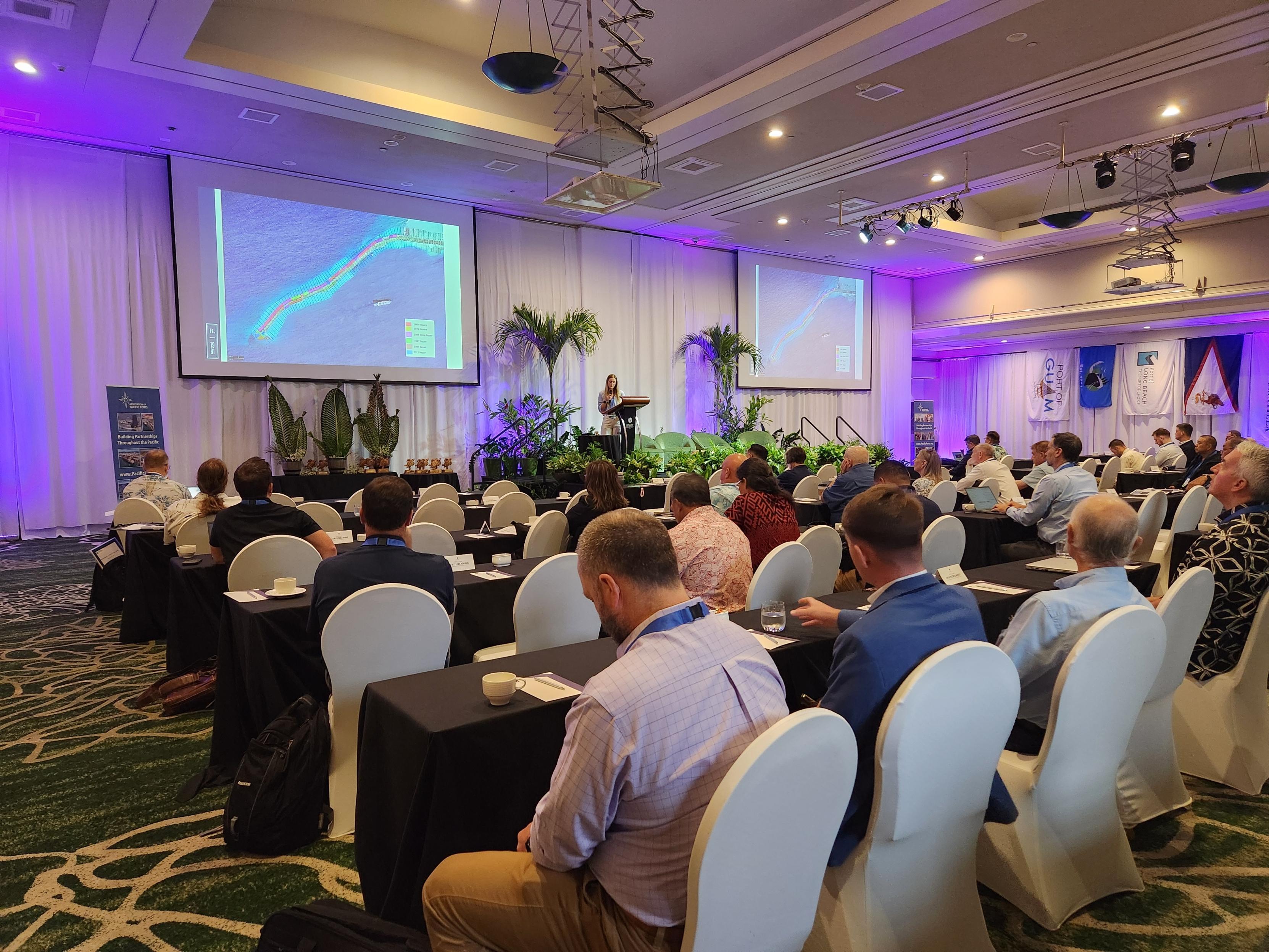
Details of the three-year project were presented during the fourth day of the Association of Pacific Ports Annual Conference, highlighting a sustainable infrastructure partnership between Black Construction Corp. and coastal engineering firm W.F. Baird & Associates. Constructed over an 80-year period, the breakwater has suffered repeated storm damage followed by fragmented, ad-hoc maintenance, including dolos unit repairs in 1984 and concrete placement in 2013.
Those past interventions created an extensive subsea "relic debris field" of displaced material surrounding the main structure. "This timeline shows how the breakwater has been kept functional through decades of patchwork repairs," said Erica Treflik-Body, junior coastal engineer and resident project representative for W.F. Baird & Associates. "Each intervention essentially bought us some time, but the structure now needs a comprehensive repair strategy to unify and strengthen it against Guam’s severe wave climate."
To stabilize the breakwater, project engineers designed a protective outer layer utilizing interlocking 16-cubic-meter acropod concrete armor units, each weighing approximately 42 tons. Rather than importing all new core material, workers are reshaping existing rocks ranging from four to 30 tons to form a continuous underlayer slope, reducing environmental impacts and construction costs.
Treflik-Body shared that decades of scattered debris created a wider physical footprint without delivering true structural durability. "The relic debris field shows that the structure has increased in its size and grown outward, but it's not necessarily stronger, reinforcing the need for this strategic repair," Treflik-Body said. To validate the design, engineers conducted two-dimensional and three-dimensional physical modeling at a one-to-50 scale at the National Research Council facility in Ottawa, Canada.
Simulations verified that the engineered acropod arrangement and an excavated foundation toe trench can withstand extreme wave conditions representing more than 100 years of storm exposure.
Active construction began in late 2025, with workers casting over 1,000 acropod units to date. A 300-foot test section was completed in May, with field teams relying on a real-time wave forecasting buoy system to maximize safe construction windows during high-swell periods. mbj
Journal Staff
The U.S. Navy’s ongoing rehabilitation of the Glass Breakwater in Apra Harbor is utilizing circular economy practices and advanced coastal engineering to reinforce the critical marine infrastructure against severe typhoons and climate change.
Details of the three-year project were presented during the fourth day of the Association of Pacific Ports Annual Conference, highlighting a sustainable infrastructure partnership between Black Construction Corp. and coastal engineering firm W.F. Baird & Associates. Constructed over an 80-year period, the breakwater has suffered repeated storm damage followed by fragmented, ad-hoc maintenance, including dolos unit repairs in 1984 and concrete placement in 2013.
Those past interventions created an extensive subsea "relic debris field" of displaced material surrounding the main structure. "This timeline shows how the breakwater has been kept functional through decades of patchwork repairs," said Erica Treflik-Body, junior coastal engineer and resident project representative for W.F. Baird & Associates. "Each intervention essentially bought us some time, but the structure now needs a comprehensive repair strategy to unify and strengthen it against Guam’s severe wave climate."
To stabilize the breakwater, project engineers designed a protective outer layer utilizing interlocking 16-cubic-meter acropod concrete armor units, each weighing approximately 42 tons. Rather than importing all new core material, workers are reshaping existing rocks ranging from four to 30 tons to form a continuous underlayer slope, reducing environmental impacts and construction costs.
Treflik-Body shared that decades of scattered debris created a wider physical footprint without delivering true structural durability. "The relic debris field shows that the structure has increased in its size and grown outward, but it's not necessarily stronger, reinforcing the need for this strategic repair," Treflik-Body said. To validate the design, engineers conducted two-dimensional and three-dimensional physical modeling at a one-to-50 scale at the National Research Council facility in Ottawa, Canada.
Simulations verified that the engineered acropod arrangement and an excavated foundation toe trench can withstand extreme wave conditions representing more than 100 years of storm exposure.
Active construction began in late 2025, with workers casting over 1,000 acropod units to date. A 300-foot test section was completed in May, with field teams relying on a real-time wave forecasting buoy system to maximize safe construction windows during high-swell periods. mbj