

















BY DANIEL M. PEREZ
Journal Staff
PITI, Guam — The Port Authority of Guam concluded fiscal year 2025 with an unmodified clean financial audit and a net position of $40.9 million, but faces narrowing operating margins that have prompted a proposed 17% multi-year tariff increase beginning in fiscal year 2026.
Independent auditors Ernst & Young LLP issued a clean opinion on the agency's financial statements and its compliance over major federal programs, identifying zero material weaknesses or significant deficiencies.The port's total assets climbed to $317.5 million, marking an increase of $13 million from the prior fiscal year, while total liabilities dropped by $38.3 million to $209.1 million.
This long-term financial stabilization occurred despite a slight contraction in total operating revenues, which fell to $57.7 million due to lower maritime cargo volumes across the waterfront.
Cargo throughput charges declined by $1.1 million as the port handled 10% less breakbulk cargo and 2% less containers, totaling 84,000 containers for the 12-month period. This container traffic includes critical transshipment cargo routed through Guam to the Northern Mariana Islands, as well as other regional Micronesian economies.
To counteract the revenue decline and offset rising inflationary pressures, the port is planning a phased 17% rate increase through fiscal year 2027 and has already implemented a new lease rate schedule projected to boost annual lease revenues by 20%. No revenues from the fiscal year were formally recorded as uncollectible under the agency's bad debt calculation policy.
Outstanding revenue bonds from the 2018 series decreased to $57.9 million due to principal payments, but structural limitations in the original bond indenture required aggressive fiscal intervention. The indenture excluded key recurring revenues from the debt service coverage ratio formula, forcing the port to execute a $3 million cash defeasance in June 2025 to maintain regulatory compliance.
Jose B. Guevara III, financial manager of the Port Authority of Guam, noted in the financial reporting that the agency ultimately achieved an annual debt service coverage ratio of 2.22, comfortably exceeding the required 1.25 benchmark. Subsequently, Guevara indicated that robust liquidity levels remain a core credit strength, with both Standard & Poor's and Moody's Investors Service maintaining a stable outlook for the agency's debt.
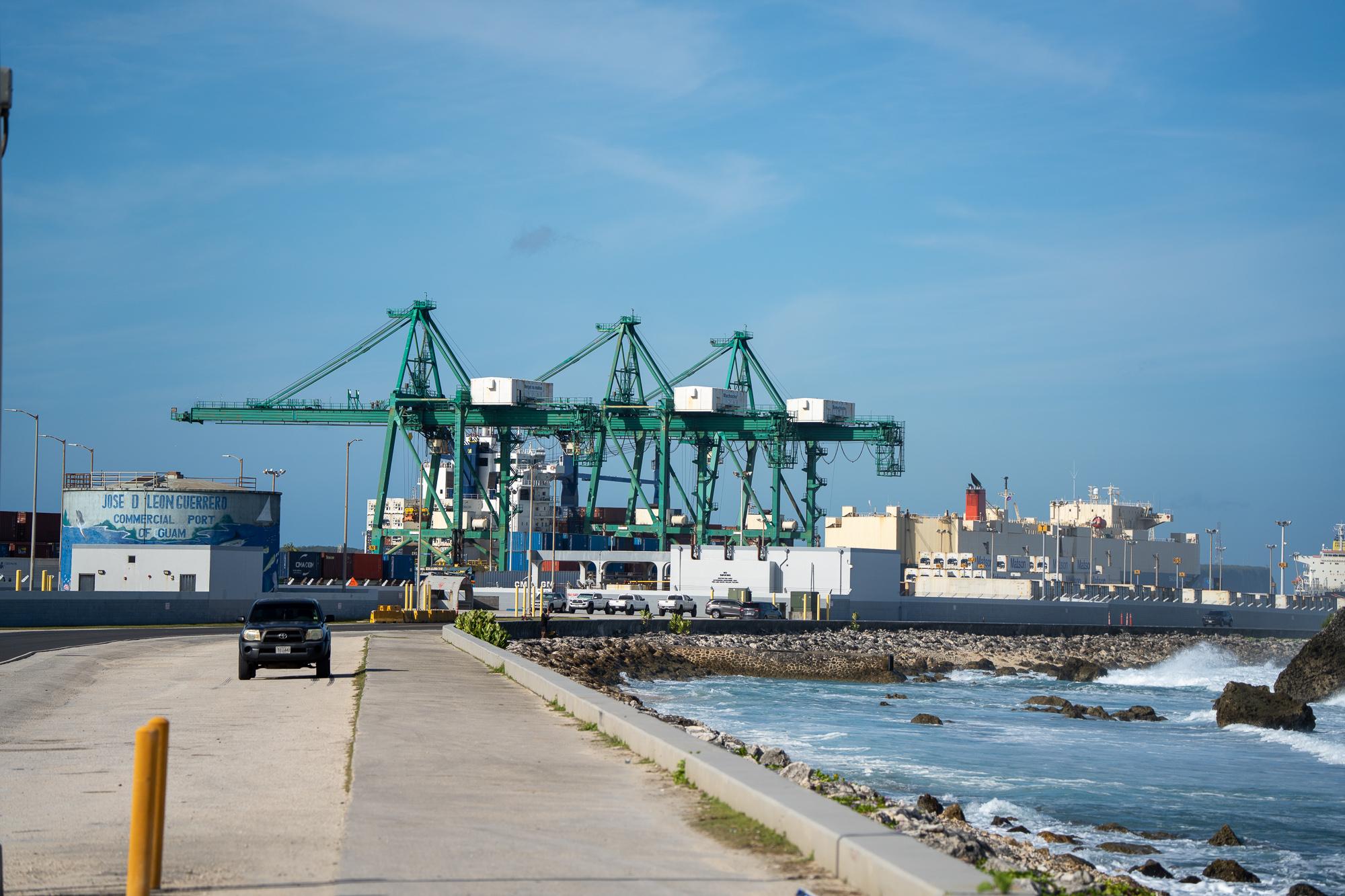
Capital improvement initiatives received a massive injection of federal support, highlighted by approximately $60 million approved in April 2026 by the U.S. Department of Transportation Maritime Administration for the acquisition of three new ship-to-shore gantry cranes, part of a $74.6 million modernization project.
Additionally, the port secured a $4.9 million Defense Community Infrastructure Program grant in September 2025 for urgent structural upgrades at the F-1 Fuel Pier.
This $7 million infrastructure restoration project represents a critical response to secure the island's energy supply chain after severe storm damage left Golf Pier completely inoperable, making the upgrades essential for military readiness, regional commerce, and civilian supply chains. mbj
Journal Staff
PITI, Guam — The Port Authority of Guam concluded fiscal year 2025 with an unmodified clean financial audit and a net position of $40.9 million, but faces narrowing operating margins that have prompted a proposed 17% multi-year tariff increase beginning in fiscal year 2026.
Independent auditors Ernst & Young LLP issued a clean opinion on the agency's financial statements and its compliance over major federal programs, identifying zero material weaknesses or significant deficiencies.The port's total assets climbed to $317.5 million, marking an increase of $13 million from the prior fiscal year, while total liabilities dropped by $38.3 million to $209.1 million.
This long-term financial stabilization occurred despite a slight contraction in total operating revenues, which fell to $57.7 million due to lower maritime cargo volumes across the waterfront.
Cargo throughput charges declined by $1.1 million as the port handled 10% less breakbulk cargo and 2% less containers, totaling 84,000 containers for the 12-month period. This container traffic includes critical transshipment cargo routed through Guam to the Northern Mariana Islands, as well as other regional Micronesian economies.
To counteract the revenue decline and offset rising inflationary pressures, the port is planning a phased 17% rate increase through fiscal year 2027 and has already implemented a new lease rate schedule projected to boost annual lease revenues by 20%. No revenues from the fiscal year were formally recorded as uncollectible under the agency's bad debt calculation policy.
Outstanding revenue bonds from the 2018 series decreased to $57.9 million due to principal payments, but structural limitations in the original bond indenture required aggressive fiscal intervention. The indenture excluded key recurring revenues from the debt service coverage ratio formula, forcing the port to execute a $3 million cash defeasance in June 2025 to maintain regulatory compliance.
Jose B. Guevara III, financial manager of the Port Authority of Guam, noted in the financial reporting that the agency ultimately achieved an annual debt service coverage ratio of 2.22, comfortably exceeding the required 1.25 benchmark. Subsequently, Guevara indicated that robust liquidity levels remain a core credit strength, with both Standard & Poor's and Moody's Investors Service maintaining a stable outlook for the agency's debt.
Capital improvement initiatives received a massive injection of federal support, highlighted by approximately $60 million approved in April 2026 by the U.S. Department of Transportation Maritime Administration for the acquisition of three new ship-to-shore gantry cranes, part of a $74.6 million modernization project.
Additionally, the port secured a $4.9 million Defense Community Infrastructure Program grant in September 2025 for urgent structural upgrades at the F-1 Fuel Pier.
This $7 million infrastructure restoration project represents a critical response to secure the island's energy supply chain after severe storm damage left Golf Pier completely inoperable, making the upgrades essential for military readiness, regional commerce, and civilian supply chains. mbj