










BY DANIEL M. PEREZ
Journal Staff
HAGÅTÑA, Guam — Government and federal emergency management executives from Guam and the Northern Mariana Islands convened at a joint press conference on June five to mark Typhoon Preparedness Month, solidifying regional infrastructure metrics and cross-territorial policy alignments.
Gov. Lourdes A. Leon Guerrero underscored that regional recovery rests upon strategic fortification and structural mitigation. "Every typhoon is going to make us even stronger and more resilient for the next," Leon Guerrero said, highlighting the critical importance of the bilateral alliance.
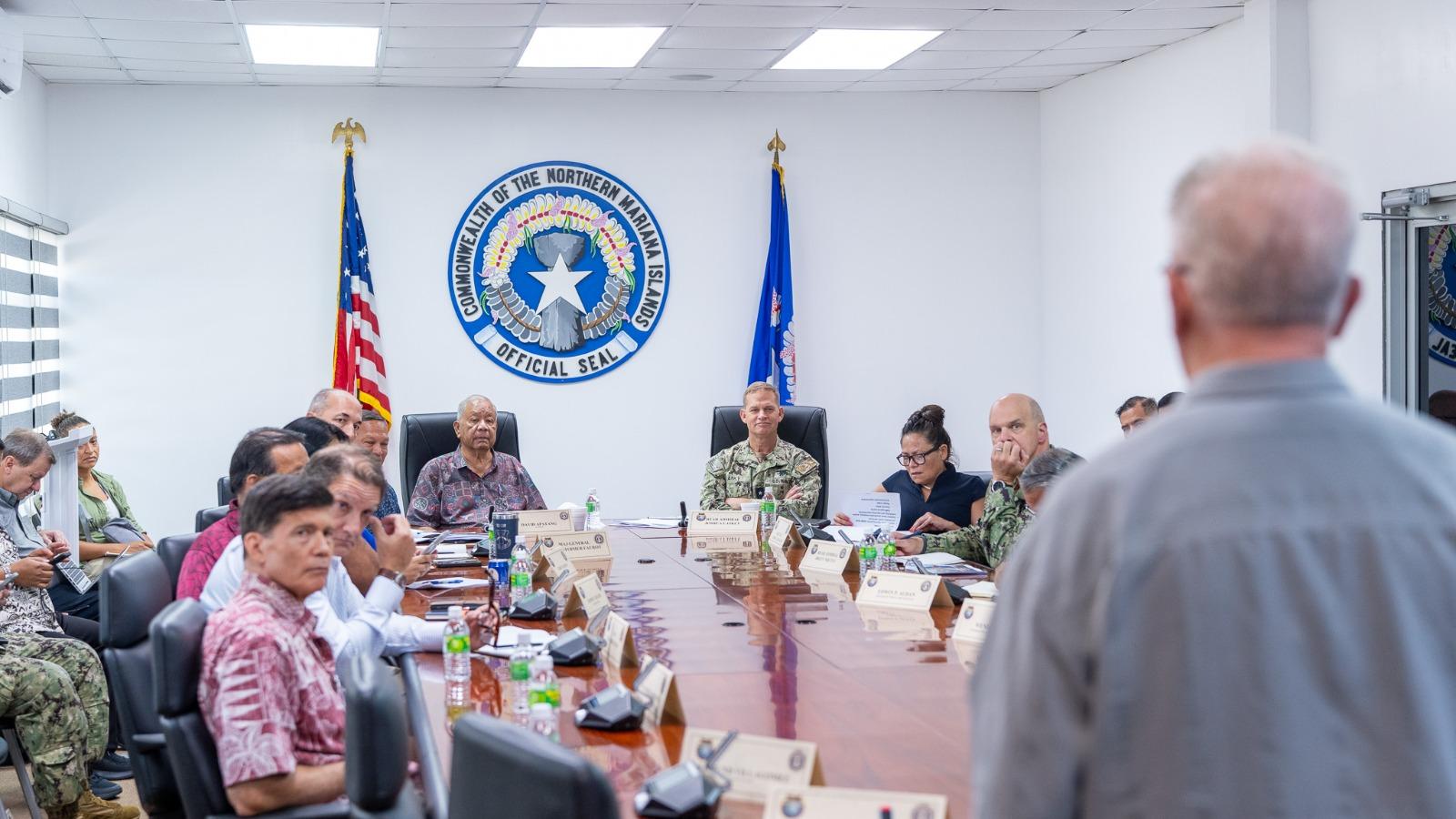
Attending the briefing virtually from Saipan, Gov. David M. Apatang, expanded on the intersectional nature of regional survival and joint logistical cooperation. Apatang declared that severe environmental events illuminate the shared resilience of Pacific communities. "Living in the Pacific means understanding that another storm may come," Apatang warned, adding that preparation today serves as the critical differentiator for future safety. He further noted that the inherent strength of the NMI is measured by how communities unify before, during, and after disasters.
Clement R. Bermudes, special assistant for the NMI Office of Homeland Security and Emergency Management, participated virtually and provided a granular assessment of ongoing infrastructure restoration following Super Typhoon Yutu.
In the primary power sector, Bermudes announced that 99% of main distribution lines on Saipan have been energized, restoring generation capacity to 34.7 megawatts. Currently, approximately 50% of electrical customers have been successfully reconnected to the local grid. Water utility metrics indicate substantial normalization, with services fully operational on Rota, 99% online on Tinian, and 98% functional on Saipan, though a precautionary boil water directive remains active for Saipan residents.
Logistical cleanup and emergency housing support have similarly advanced under multi-agency supervision. Bermudes noted that the U.S. Army Corps of Engineers has successfully processed 33,700 cubic yards of storm debris on Saipan. For immediate residential protection, disaster response teams have finalized 1,257 emergency tent placements and 312 temporary roofing repairs across the three islands, which facilitated the complete closure of all public shelters by June two. Furthermore, the Commonwealth Office of Transit Authority completed 1,407 emergency transits to support shelterees, fulfill medical needs, and facilitate airport movements.
Financial assistance remains a high priority, with federal entities driving capital distribution. Bermudes reported that the Federal Emergency Management Agency individual assistance division secured 11,103 registrations, leading to more than $21 million in total grant awards, while the U.S. Small Business Administration approved 758 disaster loans valued at over $7.4 million.
Humanitarian efforts included the distribution of 133,491 meals on Saipan, 11,520 meals on Tinian, and 18,056 meals on Rota via World Central Kitchen. Supplementing these localized numbers, Veronica L. Verde, acting senior public affairs officer for the Federal Emergency Management Agency Region Nine, participated virtually and reiterated the overarching strategy of federal operations.
Verde specified that disaster architecture functions optimally when it remains a "locally led, state/territorially managed, and federally supported" construct under the guidance of Robert J. Fenton, administrator for the Federal Emergency Management Agency Region 9.
Complementing these public and federal initiatives, the private sector has launched targeted residential relief operations to assist vulnerable populations. On June three, Triple J Real Estate Division announced an emergency temporary housing program in Saipan to aid families displaced by Super Typhoon Sinlaku. With formal authorization from the Northern Marianas Housing Corp., stringent federal income eligibility requirements have been waived through April 30, 2027. This regulatory waiver enables households previously excluded due to higher income brackets to secure safe, reliable, and stable accommodations during the critical recovery window.
Rachel Roque, property manager for Triple J Real Estate Division, stated that the relief program encompasses three specific developments: Sandy Beach Homes in Chalan Kanoa, Ocean Ridge Homes on Beach Road, and Saipan Comfort Homes in Fina Sisu.
The available semi-furnished units feature individual washers and dryers, generator backup power, solar hot water systems, backup water setups, and on-site maintenance and security services.
Applicants must verify their storm-related displacement and present valid identification alongside Social Security documentation for all household members. Roque emphasized that the firm recognizes the necessity of extending aid beyond standard business activities during regional crises. "Saipan has always been a community that comes together during difficult times, and Triple J is committed to doing our part to help families who are still recovering from the impacts of Super Typhoon Sinlaku," Roque said, adding that corporate personnel are available at the Chalan Kanoa headquarters to guide applicants through the intake process. mbj
Journal Staff
HAGÅTÑA, Guam — Government and federal emergency management executives from Guam and the Northern Mariana Islands convened at a joint press conference on June five to mark Typhoon Preparedness Month, solidifying regional infrastructure metrics and cross-territorial policy alignments.
Gov. Lourdes A. Leon Guerrero underscored that regional recovery rests upon strategic fortification and structural mitigation. "Every typhoon is going to make us even stronger and more resilient for the next," Leon Guerrero said, highlighting the critical importance of the bilateral alliance.
Attending the briefing virtually from Saipan, Gov. David M. Apatang, expanded on the intersectional nature of regional survival and joint logistical cooperation. Apatang declared that severe environmental events illuminate the shared resilience of Pacific communities. "Living in the Pacific means understanding that another storm may come," Apatang warned, adding that preparation today serves as the critical differentiator for future safety. He further noted that the inherent strength of the NMI is measured by how communities unify before, during, and after disasters.
Clement R. Bermudes, special assistant for the NMI Office of Homeland Security and Emergency Management, participated virtually and provided a granular assessment of ongoing infrastructure restoration following Super Typhoon Yutu.
In the primary power sector, Bermudes announced that 99% of main distribution lines on Saipan have been energized, restoring generation capacity to 34.7 megawatts. Currently, approximately 50% of electrical customers have been successfully reconnected to the local grid. Water utility metrics indicate substantial normalization, with services fully operational on Rota, 99% online on Tinian, and 98% functional on Saipan, though a precautionary boil water directive remains active for Saipan residents.
Logistical cleanup and emergency housing support have similarly advanced under multi-agency supervision. Bermudes noted that the U.S. Army Corps of Engineers has successfully processed 33,700 cubic yards of storm debris on Saipan. For immediate residential protection, disaster response teams have finalized 1,257 emergency tent placements and 312 temporary roofing repairs across the three islands, which facilitated the complete closure of all public shelters by June two. Furthermore, the Commonwealth Office of Transit Authority completed 1,407 emergency transits to support shelterees, fulfill medical needs, and facilitate airport movements.
Financial assistance remains a high priority, with federal entities driving capital distribution. Bermudes reported that the Federal Emergency Management Agency individual assistance division secured 11,103 registrations, leading to more than $21 million in total grant awards, while the U.S. Small Business Administration approved 758 disaster loans valued at over $7.4 million.
Humanitarian efforts included the distribution of 133,491 meals on Saipan, 11,520 meals on Tinian, and 18,056 meals on Rota via World Central Kitchen. Supplementing these localized numbers, Veronica L. Verde, acting senior public affairs officer for the Federal Emergency Management Agency Region Nine, participated virtually and reiterated the overarching strategy of federal operations.
Verde specified that disaster architecture functions optimally when it remains a "locally led, state/territorially managed, and federally supported" construct under the guidance of Robert J. Fenton, administrator for the Federal Emergency Management Agency Region 9.
Complementing these public and federal initiatives, the private sector has launched targeted residential relief operations to assist vulnerable populations. On June three, Triple J Real Estate Division announced an emergency temporary housing program in Saipan to aid families displaced by Super Typhoon Sinlaku. With formal authorization from the Northern Marianas Housing Corp., stringent federal income eligibility requirements have been waived through April 30, 2027. This regulatory waiver enables households previously excluded due to higher income brackets to secure safe, reliable, and stable accommodations during the critical recovery window.
Rachel Roque, property manager for Triple J Real Estate Division, stated that the relief program encompasses three specific developments: Sandy Beach Homes in Chalan Kanoa, Ocean Ridge Homes on Beach Road, and Saipan Comfort Homes in Fina Sisu.
The available semi-furnished units feature individual washers and dryers, generator backup power, solar hot water systems, backup water setups, and on-site maintenance and security services.
Applicants must verify their storm-related displacement and present valid identification alongside Social Security documentation for all household members. Roque emphasized that the firm recognizes the necessity of extending aid beyond standard business activities during regional crises. "Saipan has always been a community that comes together during difficult times, and Triple J is committed to doing our part to help families who are still recovering from the impacts of Super Typhoon Sinlaku," Roque said, adding that corporate personnel are available at the Chalan Kanoa headquarters to guide applicants through the intake process. mbj