Spin cycle: Laundromats are finding their footing in Palau
BY OYAOL NGIRAIRIKL
Journal Staff
Tucked in between a series of homes and businesses along a road in Medalaii, Koror, the hum of washers and smell of Bounce in dryers fills the air.
These are the sounds and smells coming from the laundromat run by Nathan and Grace Adelbai — a husband-and-wife team who started their business in 2018. They began with two machines and a simple idea that has since grown into a busy commercial laundry operation. Inside, stacks of neatly folded linens await pickup from hotels, dive operators, and live-aboard vessels.
Their story is emblematic of a quiet but steady trend reshaping Palau's small business landscape: the rise of the laundromat.
In Koror alone, there are about a dozen laundromats — a few within a five-minute walk of each other — driven by the country's tourism boom, an expanding hospitality sector, and a pandemic-era pivot toward residential customers.
Globally, the coin-operated laundry market was valued at nearly $20 billion in 2023 and is projected to nearly double to $39 billion by 2030. The same forces driving that growth — convenience, urbanization, and service-oriented lifestyles — are playing out, in miniature, in Koror.
Grace Adelbai, 37, works at Palau Dive Adventures, a dive shop run by her sister and brother-in-law. It was there, watching tourists cycle in and out of the islands and asking for help with different things, that she started filling in the gaps — until she realized those additional requests could become part of the regular service they offer.
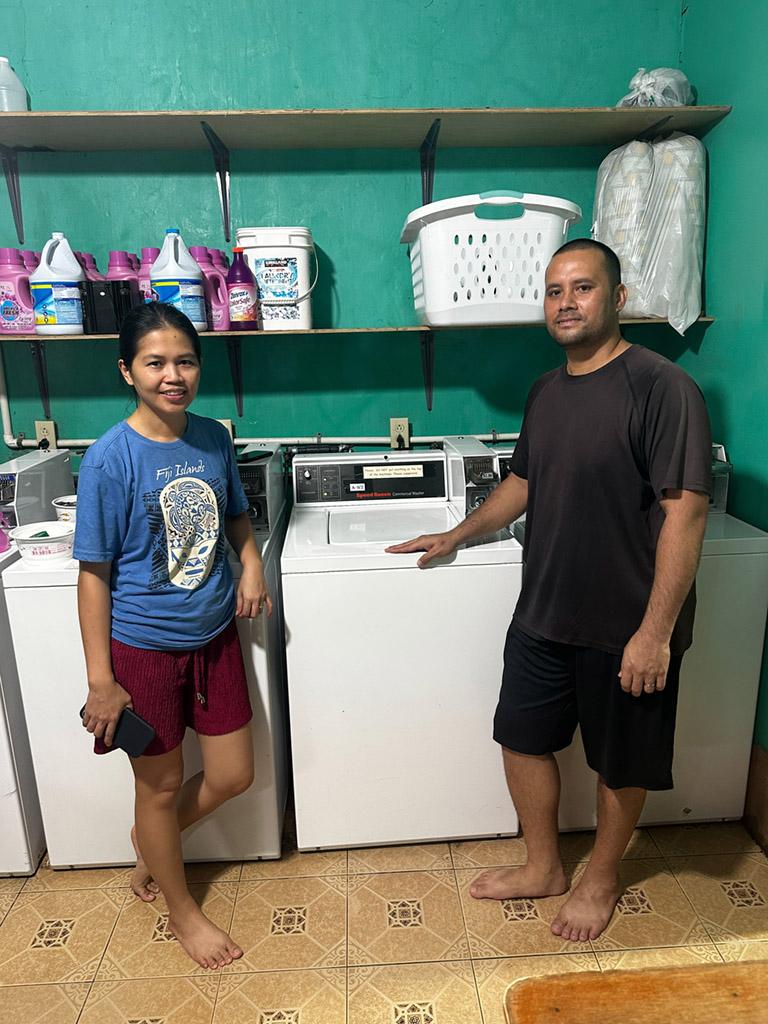
Grace and Nathan Adelbai stand in front of some of the washing machines that are the core of their laundry service business. Photo by Oyaol Ngirairikl
"The idea was to be a one-stop shop," she said. "We help book hotels, cars and other things they need when they come to Palau." It was an additional service that many divers appreciated.
"And so many of them asked about laundry services, too,” she said. So then came the next logical question: why not open their own laundry too?
She brought the idea to her husband. In 2019, the couple formally opened their laundromat in Medalaii.
Armed with a $15,000 small business loan from the National Development Bank of Palau, repayable over five years, they rewired the building behind their home, installed their first three washers and three dryers, and hired their first employee, Maricor Duran. Their target market was focused: the steady stream of visiting divers at the dive shop.
Things were good. But a year in, COVID-19 struck. Palau's government closed all commercial flights and tourism came to a halt, which meant no dive shop customers.
The couple took stock of the situation and realized they could make it work if they started taking on local customers. "We were able to get the expansion on our license," Nathan Adelbai said. "We needed that because our license when we first started was really just for the customers of the dive shop," Grace added.
Just as she had provided that extra touch of service that gave the dive shop its edge, she reconsidered what they were doing at the laundromat. First, they made it a drop-off and fold service, which was already gaining in popularity. With one additional employee, they maintained their quality of service as the customer base grew. As they focused on quick turnaround — a customer could drop off a couple of loads before the workday and pick them up afterward for about $6 a load — their popularity grew. Then they added a second service: pickup and delivery.
"We have some customers who we meet at their office in the morning and then bring back to their office later," Grace said.
Today, they are busier than ever with local residential customers. They are also serving some of Palau's most recognizable names in tourism — Fish and Fins, Four Seasons, Solitude and other live-aboard operators. Hotels including Palau Central and DW Hotels are also among their clients.
The numbers tell a story of steady, deliberate expansion. What began as three washers and three dryers has grown to a fleet of eight washers and 10 dryers, scaled up as demand from hotels and restaurants increased. The operation now employs four staff members and serves a commercial client list that stretches across Koror's hospitality corridor.
The couple is now thinking about expanding further. "We are adding more and more machines," Nathan said.
Nathan Adelbai, 40, has kept his full-time job as a firefighter for the state of Koror. The laundromat, as he described it, is a side hustle — but one he takes seriously, particularly when it comes to keeping the machines running.
His education in the trade came from an unusual source: his father. "I learned from my dad, Patrick Adelbai," Nathan said. "They have a laundromat. That's where I learned how to manage the machines and maintain them."
That knowledge, passed down through the family, has proved invaluable. Parts are expensive in Palau, and importing replacements across the Pacific is neither quick nor cheap. Labor costs compound the problem. Knowing how to diagnose and fix their own equipment has been one of the central factors in the business's survival and growth.
"Parts cost a lot — and so does labor," he said. The ability to service their own machines is not just a practical skill; it is a competitive advantage.
A five-minute walk away stands a laundromat with a longer history — and a taller building to show for it.
It occupies the ground floor of a multi-story apartment owned by Florencio Yamada, now in his 70s. The laundromat started as a side gig, an idea simmering in the background. Then, around 1987, a government furlough pushed the idea into action. Yamada and his wife, Cecelia, took the risk of building something new to ensure their family was taken care of.
They took out a loan. Yamada flew to Guam and came back with four washers and two dryers.
"At the time, most people would wash and then hang their laundry on the clothesline to dry," he said. "People didn't have a lot of money."
The laundry room was a simple extension of their existing home. They were soon popular. Together with a side job driving tourists, Yamada and Cecelia found themselves enjoying momentum in their business.
"I got a loan and we built a second story," he said, "and when we paid that loan down to a manageable level, we got another loan and built a third story." He credits much of that progress to his late wife, who he said had a head for business.
"Working together, we were able to build something that could help support our family," he added.
The building that began as a modest home with a few machines is now a three-story structure — a quiet monument to patience, discipline, and the compounding logic of reinvestment. Families in neighboring homes and tenants from the apartments above are his primary customers. When asked what advice he would give young Palauans today, Yamada did not hesitate.
"There are moments when you have to have courage and take advantage of a situation," he said. "Taking care of your family is that time."
Asked what advice they would give to others considering a similar venture, Yamada and the Adelbais were consistent in their message about making smart decisions.
"Manage your time wisely," Nathan said. "Finance wisely, and have a backup to your financial support." The dual-income household — his salary as a firefighter, her work at the dive shop — provided exactly that backstop during the lean years of the pandemic.
Grace offered a note of caution born from observation. "We knew we needed to manage it well," she said. "We service and take care of our customers. We have to really take care of them."
Their longevity, they said, comes down to those fundamentals: equipment that works, service that is reliable, and customers who feel valued.
"No regrets," Nathan said.
Their sector is not alone in its growth. Palau's broader small business environment has shifted markedly in recent years. In 2019 — the year before the COVID-19 pandemic — the Ministry of Finance issued just four new business licenses. By 2024, that number had climbed to 26. In 2025, around 40 new business licenses were issued. And in the first half of 2026 alone, about 30 new business licenses were issued. The trend points to an economy diversifying, recovering, and growing with new energy. mbj
KOROR and MELEKEOK, Palau — A select group of businesses participated in the Guam Business Magazine Trade Mission to Palau the week of Sept. 28, which was also supported by the Journal.
The United States and Australia announced on Sept. 2 at the Pacific Island Forum that each country will donate funding for the Pacific Islands, for a total of $580 million.
Qantas will double its direct service between Brisbane and Koror to two return flights a week during the peak season, after signing a new agreement to continue operating the Palau Paradise Express.