

















BY DANIEL M. PEREZ
Journal Staff
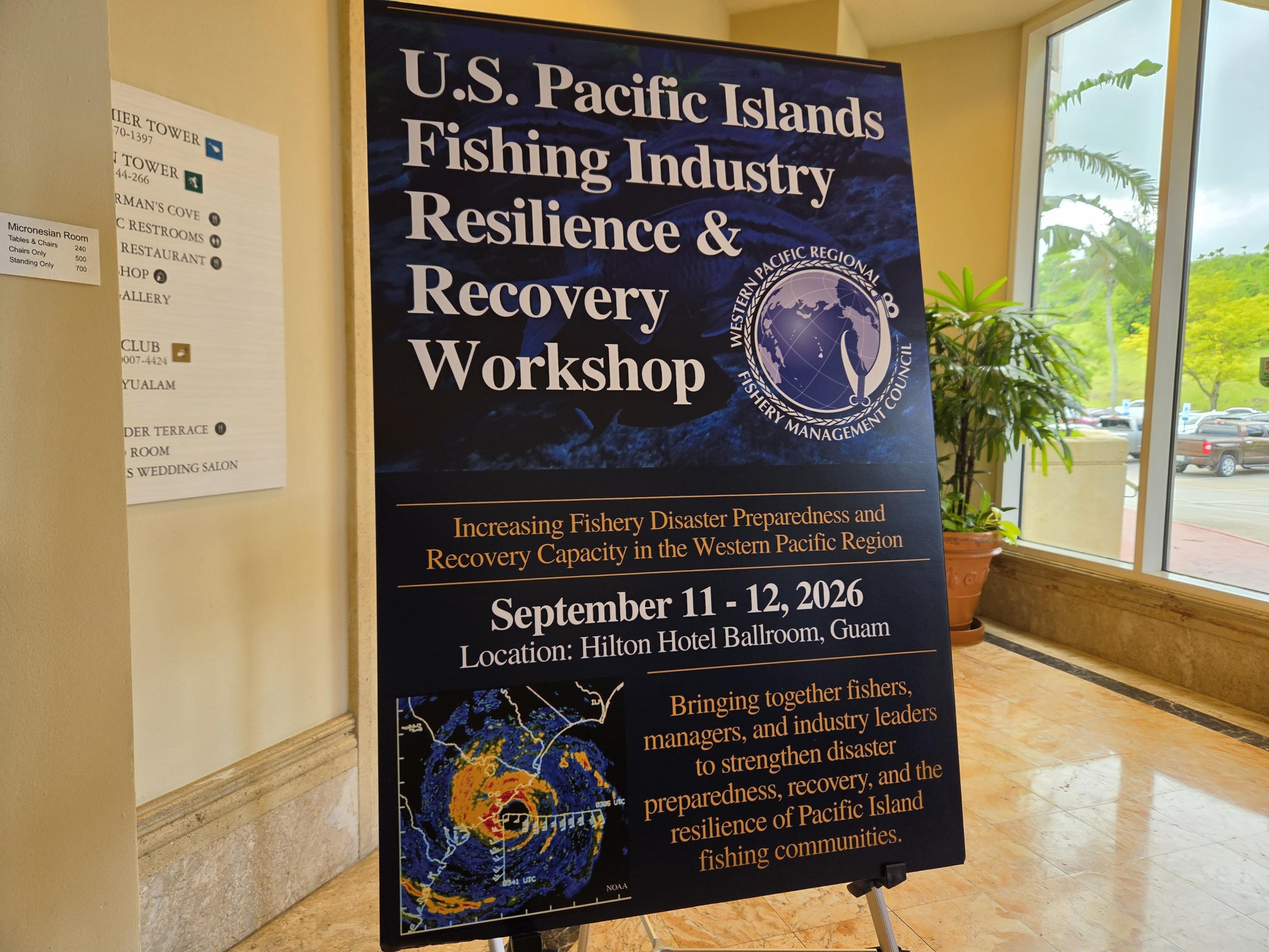
Regional fishery leaders, emergency managers, and industry stakeholders gathered at the Hilton Guam Resort & Spa on Sept. 11 and 12 for the U.S. Pacific Islands Fishing Industry Resilience & Recovery Workshop, aiming to address critical governance gaps and streamline post-disaster relief for local mariners across the Marianas.
Organized by the Western Pacific Regional Fishery Management Council in partnership with the Pacific Islands Fisheries Group, the two-day summit examined systemic obstacles that have long hampered Pacific Island communities from accessing federal disaster funding.
Since 1994, the U.S. Secretary of Commerce has declared 138 fishery disasters nationwide, directing more than $2.1 billion in Congressional relief. However, direct revenue losses over that span are conservatively estimated at more than $3.2 billion, with island fisheries historically securing only limited portions of available assistance despite suffering severe damage from recurring typhoons and natural disasters.
Mark Mitsuyasu, program officer for the Western Pacific Regional Fishery Management Council, emphasized that bringing commercial and non-commercial fishers directly into the planning process is essential for effective recovery.
"Having the fishermen's perspective in the workshop is key because it helps everybody understand really what the targeted resources should be targeting to," Mitsuyasu said. He shared that the gathering represents a milestone for regional planning following recent super typhoons in the Mariana Islands, saying, "It's really the first time that I've been involved with the council in this kind of discussion to deal with these natural disasters and impacts to the fishing community and how to support them in recovery."
Addressing maritime preparedness, Lt. Andrea Pitz, search and rescue mission coordinator for U.S. Coast Guard Forces Micronesia/Sector Guam, urged mariners to take preventative steps prior to storm landings, including securing gear, verifying radio equipment, and properly registering Emergency Position Indicating Radio Beacons. Pitz said that after ports reopen following safety assessments, local fishers play a crucial role by reporting drifting vessels, oil sheens, and navigation hazards to command centers. "The Coast Guard is here to support," Pitz said, adding that formal assistance requests must be routed through local government channels to expedite federal relief.
The workshop also highlighted preliminary findings from the 2025 Marianas Fishing Survey conducted by the National Oceanic and Atmospheric Administration's Pacific Islands Fisheries Science Center. The study surveyed 269 fishers across the region, comprising 154 respondents in Guam and 115 across Saipan, Tinian, and Rota in the Northern Mariana Islands, demonstrating the deep economic and cultural reliance on local catches.
In Guam, surveyed boat-based fishers averaged 37 trips per year, landing an average of 722 pounds of pelagic fish, 297 pounds of deep bottomfish, 165 pounds of shallow bottomfish, and 131 pounds of reef fish annually.
Surveyed fishers on Guam contributed an estimated 551,989 meals to the community, with 51% selling a portion of their catch in 2024. For those who sold fish, sales accounted for an average of 23% of personal income. Social metrics revealed that 90% of Guam respondents consider fishing an essential part of their culture, while 89% view it as a core component of their personal identity.
In the NMI, fishers averaged 30 boat trips annually, yielding an average catch of 1,092 pounds of pelagic fish, 361 pounds of deep bottomfish, 340 pounds of shallow bottomfish, and 63 pounds of reef fish per fisher. NMI respondents provided 592,494 meals to their local communities, with 54% selling fish in 2024.
Commercial fishers in the NMI reported that fish sales accounted for an average of 38% of their personal income, highlighting the heightened economic exposure local mariners face when natural disasters disrupt island harbor infrastructure.
Participants concluded the workshop with tabletop exercises simulating major tsunami and typhoon impacts, establishing framework recommendations to strengthen inter-agency communication, establish baseline data collection standards, and build long-term disaster resilience across Pacific Island fisheries. mbj
Journal Staff
Regional fishery leaders, emergency managers, and industry stakeholders gathered at the Hilton Guam Resort & Spa on Sept. 11 and 12 for the U.S. Pacific Islands Fishing Industry Resilience & Recovery Workshop, aiming to address critical governance gaps and streamline post-disaster relief for local mariners across the Marianas.
Organized by the Western Pacific Regional Fishery Management Council in partnership with the Pacific Islands Fisheries Group, the two-day summit examined systemic obstacles that have long hampered Pacific Island communities from accessing federal disaster funding.
Since 1994, the U.S. Secretary of Commerce has declared 138 fishery disasters nationwide, directing more than $2.1 billion in Congressional relief. However, direct revenue losses over that span are conservatively estimated at more than $3.2 billion, with island fisheries historically securing only limited portions of available assistance despite suffering severe damage from recurring typhoons and natural disasters.
Mark Mitsuyasu, program officer for the Western Pacific Regional Fishery Management Council, emphasized that bringing commercial and non-commercial fishers directly into the planning process is essential for effective recovery.
"Having the fishermen's perspective in the workshop is key because it helps everybody understand really what the targeted resources should be targeting to," Mitsuyasu said. He shared that the gathering represents a milestone for regional planning following recent super typhoons in the Mariana Islands, saying, "It's really the first time that I've been involved with the council in this kind of discussion to deal with these natural disasters and impacts to the fishing community and how to support them in recovery."
Addressing maritime preparedness, Lt. Andrea Pitz, search and rescue mission coordinator for U.S. Coast Guard Forces Micronesia/Sector Guam, urged mariners to take preventative steps prior to storm landings, including securing gear, verifying radio equipment, and properly registering Emergency Position Indicating Radio Beacons. Pitz said that after ports reopen following safety assessments, local fishers play a crucial role by reporting drifting vessels, oil sheens, and navigation hazards to command centers. "The Coast Guard is here to support," Pitz said, adding that formal assistance requests must be routed through local government channels to expedite federal relief.
The workshop also highlighted preliminary findings from the 2025 Marianas Fishing Survey conducted by the National Oceanic and Atmospheric Administration's Pacific Islands Fisheries Science Center. The study surveyed 269 fishers across the region, comprising 154 respondents in Guam and 115 across Saipan, Tinian, and Rota in the Northern Mariana Islands, demonstrating the deep economic and cultural reliance on local catches.
In Guam, surveyed boat-based fishers averaged 37 trips per year, landing an average of 722 pounds of pelagic fish, 297 pounds of deep bottomfish, 165 pounds of shallow bottomfish, and 131 pounds of reef fish annually.
Surveyed fishers on Guam contributed an estimated 551,989 meals to the community, with 51% selling a portion of their catch in 2024. For those who sold fish, sales accounted for an average of 23% of personal income. Social metrics revealed that 90% of Guam respondents consider fishing an essential part of their culture, while 89% view it as a core component of their personal identity.
In the NMI, fishers averaged 30 boat trips annually, yielding an average catch of 1,092 pounds of pelagic fish, 361 pounds of deep bottomfish, 340 pounds of shallow bottomfish, and 63 pounds of reef fish per fisher. NMI respondents provided 592,494 meals to their local communities, with 54% selling fish in 2024.
Commercial fishers in the NMI reported that fish sales accounted for an average of 38% of their personal income, highlighting the heightened economic exposure local mariners face when natural disasters disrupt island harbor infrastructure.
Participants concluded the workshop with tabletop exercises simulating major tsunami and typhoon impacts, establishing framework recommendations to strengthen inter-agency communication, establish baseline data collection standards, and build long-term disaster resilience across Pacific Island fisheries. mbj